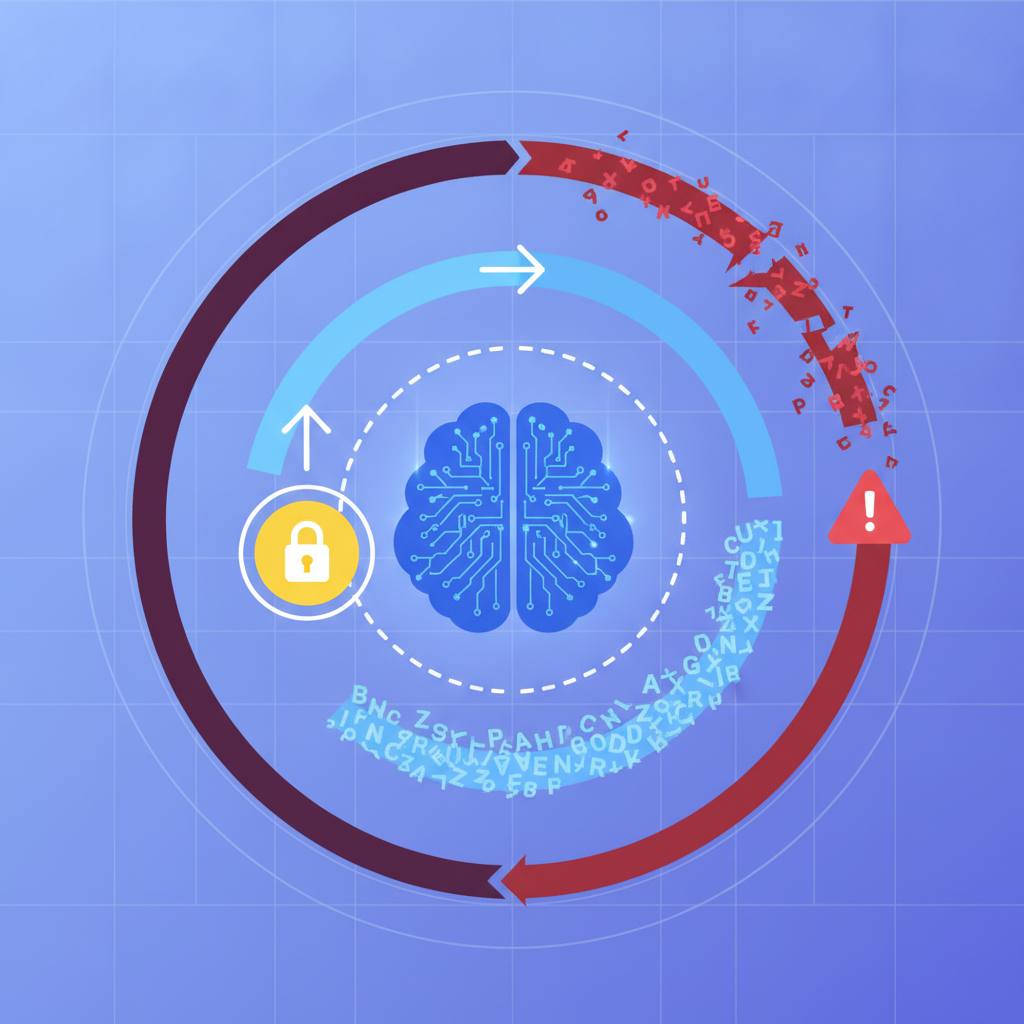
Securing Large Language Models (LLMs) against 'prompt injection' attacks has become critical, necessitating an external protection system that sits between the model and its tools, which the model literally cannot bypass.
We can no longer rely on Large Language Models (LLMs) to secure themselves when interacting with external tools. In fact, placing a crucial guard between your LLM and its tools is now an urgent necessity. This means the way we design AI systems needs a fundamental change to ensure their safety and integrity.
Imagine asking an AI model to read a webpage or summarize a document, and then use a specific tool. The problem arises when that page or document contains hidden instructions or 'prompt injections' designed to trick the model into doing something it shouldn't, like accessing sensitive information or performing incorrect operations. This is very similar to 'SQL injection' attacks that targeted databases, where attackers tricked the system into executing unauthorized commands. The difference today is that the 'untrusted input' is no longer just a form field on a webpage; it's the content the model reads and processes.
The model itself, no matter how well-tuned, is not a security boundary. It's more like a surface that takes input and produces output, and it cannot be responsible for enforcing security policies on itself. Asking it to do so is like asking a con artist's mark to also serve as the fraud investigator. Trying to 'prompt-engineer' your way out of it—using better system prompts or stern warnings to the model not to follow malicious instructions—is not an effective security control; these are just suggestions, and suggestions don't stop attacks.
The solution lies in placing a proxy or 'deterministic cop' between the model and its tools, acting as an additional layer of protection. This layer enforces security policies and verifies all requests before they reach the tools, in a way that the model cannot bypass or 'reason its way around.' In other words, the enforcement point must be somewhere the attacker's payload cannot touch or manipulate. This has become even more urgent with the standardization of how agents discover and call tools, making potential attacks more consistent and dangerous across different implementations. Therefore, the risks associated with 'prompt injection attacks' are not overstated at all; if anything, they are often underestimated outside the circles of specialists who have actually red-teamed these systems. To ensure a secure future for AI, we must build these security barriers as an integral part of our system design, not as an option that can be postponed.
Imagine asking an AI model to read a webpage or summarize a document, and then use a specific tool. The problem arises when that page or document contains hidden instructions or 'prompt injections' designed to trick the model into doing something it shouldn't, like accessing sensitive information or performing incorrect operations. This is very similar to 'SQL injection' attacks that targeted databases, where attackers tricked the system into executing unauthorized commands. The difference today is that the 'untrusted input' is no longer just a form field on a webpage; it's the content the model reads and processes.
The model itself, no matter how well-tuned, is not a security boundary. It's more like a surface that takes input and produces output, and it cannot be responsible for enforcing security policies on itself. Asking it to do so is like asking a con artist's mark to also serve as the fraud investigator. Trying to 'prompt-engineer' your way out of it—using better system prompts or stern warnings to the model not to follow malicious instructions—is not an effective security control; these are just suggestions, and suggestions don't stop attacks.
The solution lies in placing a proxy or 'deterministic cop' between the model and its tools, acting as an additional layer of protection. This layer enforces security policies and verifies all requests before they reach the tools, in a way that the model cannot bypass or 'reason its way around.' In other words, the enforcement point must be somewhere the attacker's payload cannot touch or manipulate. This has become even more urgent with the standardization of how agents discover and call tools, making potential attacks more consistent and dangerous across different implementations. Therefore, the risks associated with 'prompt injection attacks' are not overstated at all; if anything, they are often underestimated outside the circles of specialists who have actually red-teamed these systems. To ensure a secure future for AI, we must build these security barriers as an integral part of our system design, not as an option that can be postponed.