Relying solely on database backups might not be enough to fully restore your system when disaster strikes. Many other crucial parts of your application are often forgotten.
Many people believe that simply backing up their database is enough to protect their applications. But here's the uncomfortable truth: that's often only half the story! What does this mean for you? Well, if something goes wrong and your backup strategy isn't comprehensive, you could find yourself facing days of difficult, manual work just to try and get things back to normal.
Consider this real-world situation: At a plant in Dongguan, an IT manager faced a nightmare when one of her admins ran a bulk update with the wrong filter, blanking out 60,000 vital rows in an inspection table. Her request was clear: «I need you to restore that one table from last night. Everything else – the other thirty applications, the production dashboard, the approval queues – has to keep running.» It took four days, and most of the work was manual. Why? Because their 'backup' was just database dumps, which captured only «part of the state,» not the entire application.
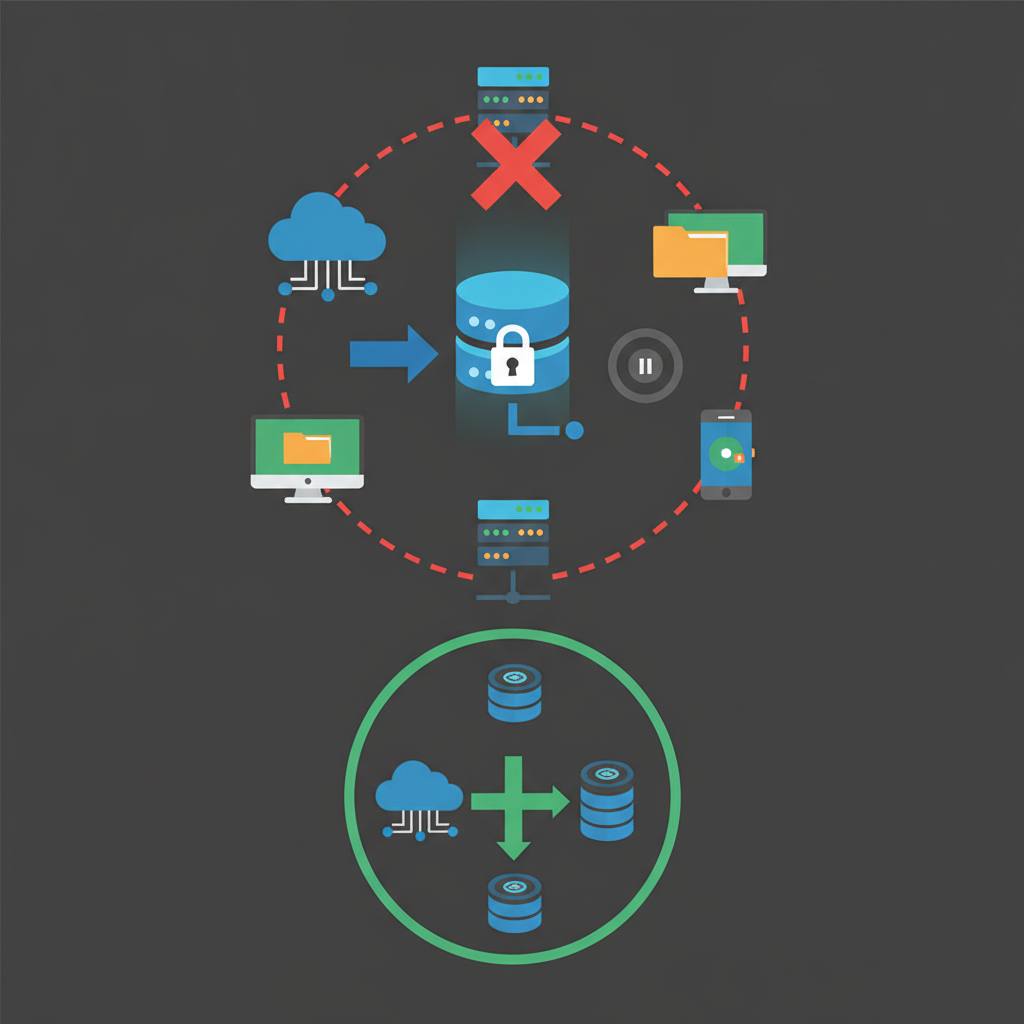
This is the hard arithmetic: when you dump the platform database, you've captured only a fraction of your system's true state. There are so many missing pieces that, while not exotic, are just boring enough that nobody truly owns their backup responsibility. For instance, user identities and permissions might live in a separate library. Business data itself could be sharded across multiple parts. Uploaded files, like scanned certificates or photos attached to records, reside somewhere else entirely—often in object storage buckets or local file directories. Even the search index, which we tell ourselves doesn't need a backup because it's derived, becomes crucial when you restore and suddenly the search box goes quiet.
So, the sentence «we back up the database» describes roughly half of the stateful parts of your system. It happens to be the half that's easiest to describe, which is why everyone tends to stop there. To ensure you're truly prepared for any emergency, you need to think about *all* the components of your application, not just the database.
Consider this real-world situation: At a plant in Dongguan, an IT manager faced a nightmare when one of her admins ran a bulk update with the wrong filter, blanking out 60,000 vital rows in an inspection table. Her request was clear: «I need you to restore that one table from last night. Everything else – the other thirty applications, the production dashboard, the approval queues – has to keep running.» It took four days, and most of the work was manual. Why? Because their 'backup' was just database dumps, which captured only «part of the state,» not the entire application.
This is the hard arithmetic: when you dump the platform database, you've captured only a fraction of your system's true state. There are so many missing pieces that, while not exotic, are just boring enough that nobody truly owns their backup responsibility. For instance, user identities and permissions might live in a separate library. Business data itself could be sharded across multiple parts. Uploaded files, like scanned certificates or photos attached to records, reside somewhere else entirely—often in object storage buckets or local file directories. Even the search index, which we tell ourselves doesn't need a backup because it's derived, becomes crucial when you restore and suddenly the search box goes quiet.
So, the sentence «we back up the database» describes roughly half of the stateful parts of your system. It happens to be the half that's easiest to describe, which is why everyone tends to stop there. To ensure you're truly prepared for any emergency, you need to think about *all* the components of your application, not just the database.