Are you guessing when evaluating Large Language Models? Discover how relying on manual «looks good to me» methods led to critical errors in a customer support LLM, highlighting the urgent need for robust, automated evaluation pipelines to prevent misinformation in production.
Have you ever launched a system powered by Large Language Models (LLMs), feeling completely confident it would work perfectly, only to find out it was giving totally wrong answers? That's exactly what happened to one tech team. What this means for you is that relying on personal impressions to evaluate these models is never enough, and can lead to unfortunate outcomes affecting users and customer trust.
Three months ago, a team shipped a RAG-based customer support assistant. During testing, everything seemed great. They would ask the assistant questions, read the answers, and say, 'Yeah, that looks right.' But when the system hit production, problems started surfacing. A customer asked about their billing cycle, and the assistant confidently cited a policy that didn't exist. Another asked about API rate limits and got numbers from a competitor's documentation!
Before the team could catch the errors, over 500 users had already seen incorrect responses, or what are called «hallucinations». The post-mortem was clear and brutal: they had zero automated evaluation. Their test process was literally 'ask 5 questions, read answers, thumbs up.' Even well-known academic benchmarks like MMLU or HellaSwag don't tell you if your system works for your specific use case.
Real-world evaluation in a production environment demands a completely different approach. You need:
* Domain-specific judges: Your evaluation criteria must be specific to your needs, not just «generally helpful».
* Speed: Evaluation must run within your continuous integration/continuous deployment (CI/CD) pipeline, not take an entire night.
* Regression detection: Know immediately if a prompt change breaks things or degrades quality.
* CI/CD integration: Block merges that would reduce quality.
* Golden dataset management: Versioned, stratified, and continuously growing test cases.
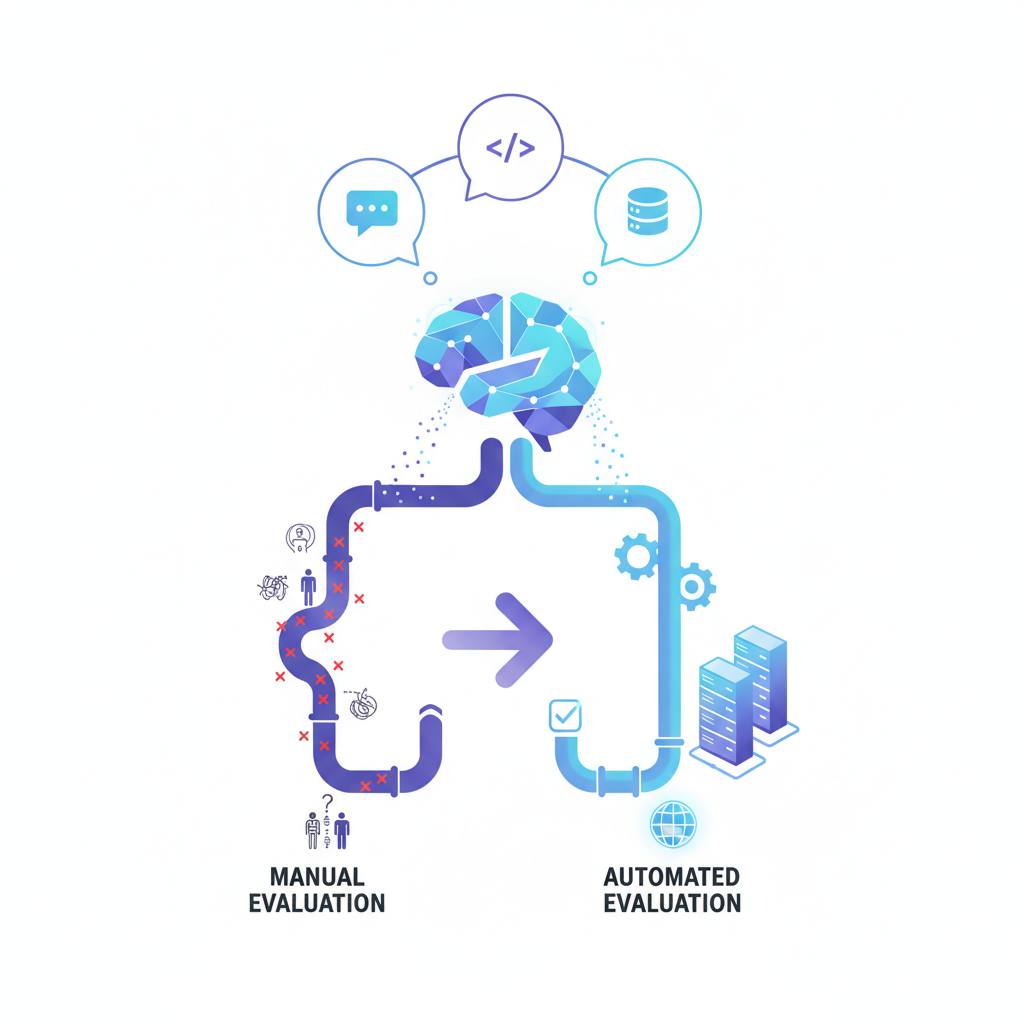
This means you prepare a set of test cases (the golden set) that are fed to the LLM under test. Then, a «judge ensemble» – which evaluates aspects like faithfulness, instruction following, and JSON schema validity – assesses the model's responses. These evaluations are then analyzed to extract clear metrics, detect any performance regressions, and displayed in dashboards or directly in Pull Request comments. This shift from guesswork to metrics ensures your LLMs perform as expected, provide reliable information to your users, and maintain your business's reputation. Don't let «looks good to me» fool you again!
Three months ago, a team shipped a RAG-based customer support assistant. During testing, everything seemed great. They would ask the assistant questions, read the answers, and say, 'Yeah, that looks right.' But when the system hit production, problems started surfacing. A customer asked about their billing cycle, and the assistant confidently cited a policy that didn't exist. Another asked about API rate limits and got numbers from a competitor's documentation!
Before the team could catch the errors, over 500 users had already seen incorrect responses, or what are called «hallucinations». The post-mortem was clear and brutal: they had zero automated evaluation. Their test process was literally 'ask 5 questions, read answers, thumbs up.' Even well-known academic benchmarks like MMLU or HellaSwag don't tell you if your system works for your specific use case.
Real-world evaluation in a production environment demands a completely different approach. You need:
* Domain-specific judges: Your evaluation criteria must be specific to your needs, not just «generally helpful».
* Speed: Evaluation must run within your continuous integration/continuous deployment (CI/CD) pipeline, not take an entire night.
* Regression detection: Know immediately if a prompt change breaks things or degrades quality.
* CI/CD integration: Block merges that would reduce quality.
* Golden dataset management: Versioned, stratified, and continuously growing test cases.
This means you prepare a set of test cases (the golden set) that are fed to the LLM under test. Then, a «judge ensemble» – which evaluates aspects like faithfulness, instruction following, and JSON schema validity – assesses the model's responses. These evaluations are then analyzed to extract clear metrics, detect any performance regressions, and displayed in dashboards or directly in Pull Request comments. This shift from guesswork to metrics ensures your LLMs perform as expected, provide reliable information to your users, and maintain your business's reputation. Don't let «looks good to me» fool you again!